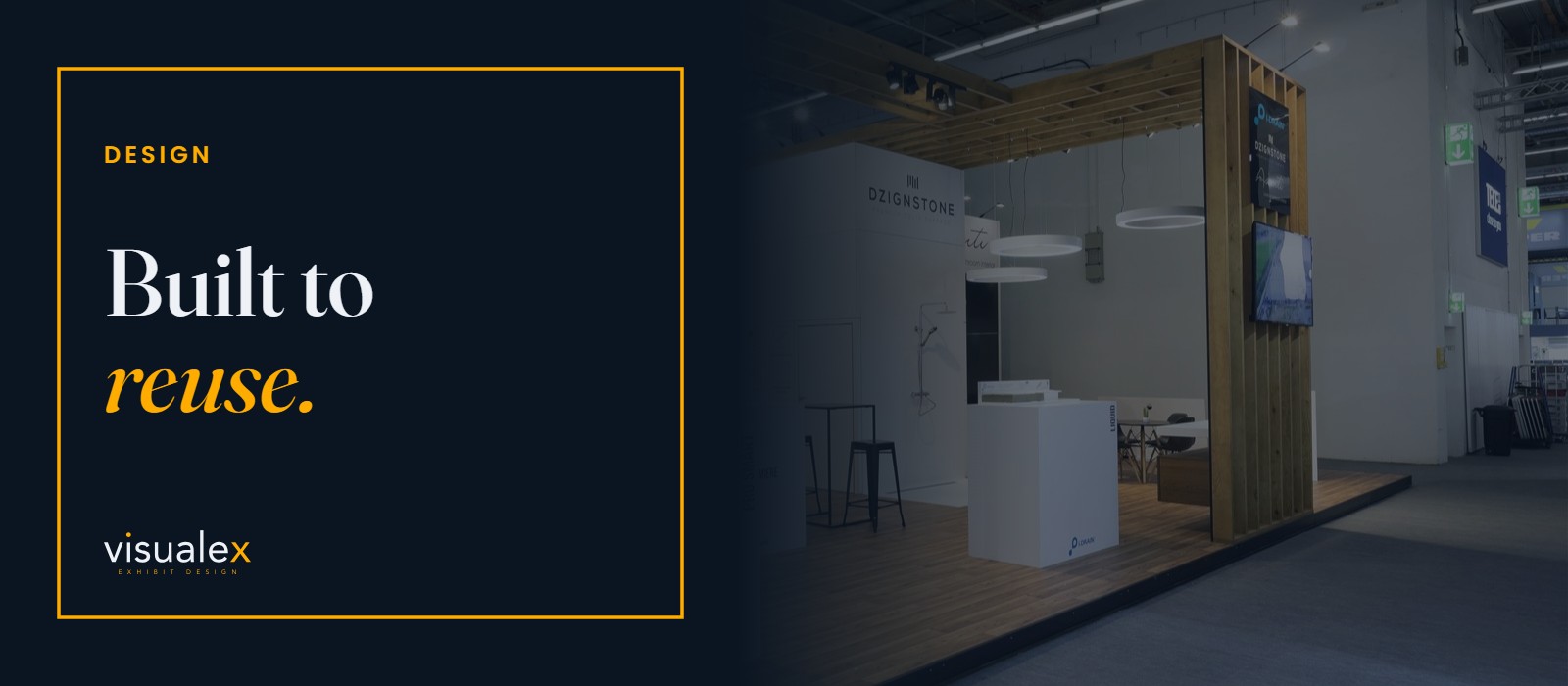
Ask for a sustainable exhibition stand and most builders reach for the same answer: a rental kit. Aluminum extrusions, tension fabric, a logo swap — and a booth that looks like the three next to it. Sustainability matters. So does standing out. The good news: the greenest stand on the floor can also be the most distinctive — if it’s designed that way from day one.
Trade shows have a waste problem — and a sameness problem
Walk a hall on teardown day and you’ll see the problem — walls, graphics, and carpet heading for the dumpster hours after the last handshake. Most of what gets built for a trade show is built for that trade show alone. The industry’s standard fix is the modular rental system: hardware that gets reused, yes — but architecture that was never yours. Your brand shrinks to a printed panel clipped onto the same frame your competitor rented last month. An eco-friendly trade show booth that also disappears into the row beside it isn’t much of a win.
That’s the false choice exhibitors have been sold: custom and wasteful, or responsible and forgettable. It doesn’t hold. Reuse isn’t a product category — it’s an engineering decision. A custom stand designed to come back is greener than a rental precisely because you own it, control it, and rebuild it on your terms.
Design for reuse: the reusable exhibition stand you own outlives the show
A rented stand returns to a warehouse and to somebody else’s inventory. A reusable exhibition stand you own can be engineered — from the first render — to live across an entire show calendar. That means structure planned in transportable sections. Finishes specified to survive repeated assembly, not just one opening night. A layout that adapts from a corner booth at one fair to an island at the next, keeping the hero elements — the counter, the rear wall, the lightbox — intact.
That adaptability is a design job done up front, not a lucky accident later. The same stand re-plans from an inline slot with one open side, to a corner with two, to an island exposed on all four — because the modules were drawn to regroup around a fixed kit of parts. The counter moves. The rear wall splits or rotates. The lightbox becomes a divider. You’re not rebuilding the stand for each footprint; you’re re-arranging a stand you already own. That’s where the reuse actually pays — every show that reuses 80% of last show’s structure is a show you didn’t send to the dumpster.
The discipline behind this is design for disassembly. Bolted connections instead of glue. Panels that separate without splintering. Wiring that unplugs instead of being cut out. When a stand comes apart in order, it goes back together for the next show in less time, with less damage — and at true end of life, its materials stay identifiable, separable, and recoverable instead of fused into waste.
Materials and light: where the footprint actually drops
Start with the structure. Responsibly sourced wood — FSC-certified where available — comes from forests managed to protect biodiversity and the communities around them. It’s also simply better material for a stand that has to come back: durable, repairable, refinishable, warm under light in a way no aluminum extrusion will ever be.
That refinishability is where the economics quietly turn in your favor. A wood surface that scuffs gets sanded and recoated between shows instead of scrapped — a fraction of the cost of rebuilding, and none of the waste. Then attack the graphics. Single-use PVC banners are the show floor’s most disposable habit — printed for three days, buried for decades. Where possible, specify PVC-free substrates or textile graphics designed to be swapped: reprint a lightweight fabric skin for a new message and the whole structure stays put. The frame returns show after show; only the printed textile changes — and a textile swap costs a sliver of a full rebuild while keeping the message current.
And light everything with LED. LEDs use at least 75% less energy than incandescent sources and last up to 25 times longer — and they run cooler, which matters when your stand is made of wood and fabric rather than metal and plastic.
Build near the venue — freight is the hidden emission
Here’s the variable most sustainability checklists skip: distance. A booth shipped across an ocean drags a freight footprint that no bamboo counter can offset. Building near the venue shortens the whole chain — fewer crates, fewer trucks, no air-freight panic when something breaks — and puts a workshop close enough to respond overnight instead of in three weeks.
Not all freight is equal, either. A stand trucked overland within the region carries a fraction of the emissions of the same crates flown in — and air freight is exactly what you fall back on when a border delay or a broken panel forces a last-minute fix. Keep the build close and road transport stays the default; ship it from another continent and you’ve designed air freight into the plan whether you meant to or not. For shows in Colombia, that logic is the model Visualex was built on: stands designed, produced, and installed in Bogotá by one in-house team, so nothing crosses a border to reach the floor. Local production isn’t a compromise on ambition — it’s what makes ambition affordable to sustain.
Five questions that separate green from greenwash
Any builder can put a leaf icon on a proposal. The difference between practice and greenwash shows up in the answers to specific questions — ask these before you sign, and listen for hesitation.
- 1Where does the stand go next?A real answer names storage, a rebuild plan, and end-of-life recovery — not a dumpster.
- 2Can it rebuild in another footprint?A stand engineered for reuse adapts from a corner space to an island without starting from zero.
- 3What’s bolted, and what’s glued?Mechanical connections come apart clean and survive assembly cycles — adhesive is where reuse dies.
- 4Which materials carry certification?Responsibly sourced wood and PVC-free graphics should be specified in writing, not implied in a brochure.
- 5How far will the build travel?Every border and every extra truck adds emissions — a workshop near the venue is a design decision too.
The most sustainable stand on the floor isn’t the one that looks recycled — it’s the one you never have to throw away.